
What phrases feel overhyped or evasive? Premium clients are wary of phrases that sound impressive but do not explain the offer. When your website calls you “trusted,” “results-driven,” or “tailored” without showing what you do, the problem you solve, or the evidence behind the claim, a buyer has to fill in the gaps. They may expect the same vagueness after they book, so replace broad promises with language that names the problem, the work, and the result you can credibly support.
Which phrases make premium clients skeptical?
Premium clients become skeptical when a claim sounds bigger than the evidence beside it. Words such as “best-in-class,” “industry-leading,” “proven,” “holistic,” “client-centric,” and “customized” are not automatically dishonest, but they often mean so many things that they stop meaning much.
A coach might write, “I offer transformational coaching for ambitious leaders,” while a consultant might say, “We provide comprehensive strategic solutions.” Both lines sound polished, yet neither tells a buyer the transformation you promise, who the work is for, or why this you are a fit. Furthermore, the issue is not that premium buyers dislike confidence, but that they dislike being asked to supply the missing details themselves. 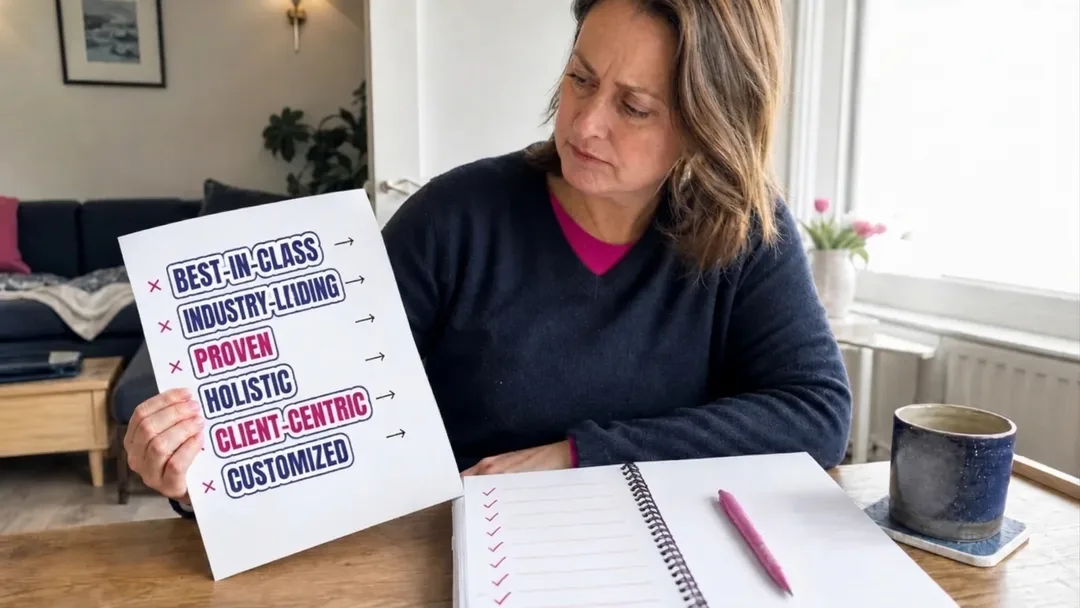
A strong claim gives a buyer something they can test; compare these pairs:
- Vague: “Trusted guidance for your next level.”
- Clearer: “Clarify the offer and message that help qualified prospects understand why they should book a call.”
- Vague: “A customized approach for every client.”
- Clearer: “Your strategy starts with the buyer problem, offer, and client path before any website message is written.”
- Vague: “Proven results for growing businesses.”
- Clearer: “We help service businesses replace unclear website messaging with a path that supports trust and booked calls,” and the clearer line does not guarantee an outcome, but it shows what the work is designed to do.
Why do vague promises feel evasive?
Vague promises feel evasive because they hide the limits, method, and proof a buyer needs. When someone is considering a higher-value service, they are not only asking whether you sound capable; they are asking what they are actually buying.
Picture a consultant with a new offer: one provider promises “rapid growth through strategic alignment,” another identifies its costly problem, sharpens the message, and maps a prospect’s next step. The second provider may not sound flashier, but the buyer can see the work.
Research cited by Nielsen Canada found that only 59% of Canadians trusted advertising completely or somewhat. That research is older and should not be treated as a current measurement of every buyer, but it still points to a familiar problem: advertising trust cannot be assumed. For coaches, consultants, and service-based entrepreneurs, the practical lesson is simple: do not ask a prospect to trust a claim that your page has not explained.
What should you say instead of “trusted” or “proven”?
Use evidence, not labels. Replace “trusted” or “proven” with the evidence or experience that earns the claim, and if you cannot place evidence beside the word, remove the word and let the detail do the work.
For example, Iconic Digital World can point to over a decade of work and 600+ clients, but those facts should support a relevant claim rather than become decoration. A reader deciding whether to clarify a weak offer needs to know how Brand Strategy helps, not simply how long someone has been in business.
Moyin wrote on Trustpilot: “I’m very happy with our website. [Iconic] is highly knowledgeable and very professional. [They] delivered beyond my expectations,” which supports a claim about professionalism and delivery. It does not prove that every future client will get the same outcome.
Use this decision rule:
- Say “clients describe the work as professional” when you have a relevant review.
- Use “built from over a decade of work with 600+ clients” when experience explains why you use a process.
- Say “designed to help” when the result depends on client decisions, timing, and follow-through.
- Avoid “proven to get results” unless you can name the precise result and evidence without stretching it; in my work with coaches and consultants, unclear claims are often not a writing problem alone but usually point to an offer that has not yet chosen the exact problem it wants to own.
How can you make a bold promise without overpromising?
Promise only what you can influence. You can make a bold promise by being precise about the change you help create and honest about what remains outside your control.
A weak promise tries to cover every possible result: “Build your authority, scale your impact, attract ideal clients, and transform your business.”
A more credible promise chooses one job: “Turn an unclear service offer into a message that helps the right prospect understand why a Free Strategy Call is worth taking.”
The second line does not promise revenue, premium clients, or instant growth, yet addresses a real barrier: buyers who cannot understand the offer rarely take the next step. The 4 Gates of Client Acquisition offers a useful check at this point.
SEE: Is Gate 1 open? Do they see that you have the solution to their problems?
FEEL: Is Gate 2 open? Do they quickly feel you you are trustworthy and credible? A bold promise must help open both gates, which means it needs clarity as well as proof. Ask yourself these questions before publishing a headline or offer statement:
- Can a buyer identify the problem in their own words?
- Does the promise describe a change you can influence directly?
- Have you explained the work that connects the problem to the outcome?
- Is there proof, context, or a clear limit near the claim?
If the answer to the last question is no, soften the claim or add the missing detail; that is not weaker marketing but a fairer buying decision.
When does “customized” help instead of hurt?
“Customized” helps when you explain what changes and what stays consistent. Without that explanation, it can sound like a polite way of avoiding scope, process, or a clear answer.
Try contrast instead: “The strategy is shaped around your offer, buyer, and current client journey, while the process follows clear steps to clarify your positioning, messaging, and next action.” Now the reader knows where adaptation happens and where your expertise gives the work structure.
This matters especially when your website feels like a collection of services rather than one coherent offer. The article on explaining what your business does can help you find the plain-language foundation before you try to make the message sound distinctive.
What can you put beside your claims to earn trust?
Match proof to the claim. Put useful proof beside your claims so buyers can assess the offer without taking your word for it.
Choose evidence that matches the claim:
- For expertise: Name relevant experience, a specific process, or a focused area of work.
- To show understanding: Use the language your buyer uses for the costly problem they are living with.
- On reliability: Explain the next step, timeline, and what you need from the client.
- For social proof: Use reviews exactly as written and only for the point they support.
- To establish fit: State who the offer is for and who may need something else.
 The key elements of a web page matter here because a strong promise can still fail when the surrounding page gives the reader no clear route to understand it or act on it.
How do you audit your own marketing language?
Challenge every claim. Audit your marketing language, marking every claim a buyer could challenge, then adding detail, evidence, or a limit. Start with your homepage headline, service-page opening, call-to-action, proposal, and the first email you send after an inquiry.
Use this short review:
- Circle words such as “leading,” “trusted,” “proven,” “unique,” “tailored,” and “results.”
- Ask what a skeptical prospect would need to see before believing each one.
- Replace the word with the detail when possible, and keep one clear claim per section instead of stacking several broad promises.
- Read the page aloud and notice where you would ask, “What does that actually mean?”
Across a decade of work, I have learned that the clearest message is usually not the most elaborate one but the one that respects the buyer enough to name the problem plainly, explain the work, and show a believable next step. If you want help finding the phrases that make your offer sound broad, the Magnetic Growth System helps you clarify your offer, messaging, and client path so online interest has a clearer route toward premium-client trust and booked calls. You can start with a Free Strategy Call when you are ready to look at the gap between what your website says and what the right buyer needs to understand.
What should you do before rewriting every page?
Choose the buyer problem first. Before rewriting every page, you need to decide which buyer problem your offer is built to solve, as new wording will not hold if the offer behind it is still trying to be everything to everyone.
Start with one sentence: “I help this person deal with this costly problem by doing this work, so they can move toward this practical result.” Then test it against the words your best-fit buyers use before they buy.
A clear offer can make your website, conversations, and follow-up feel consistent, and it also makes it easier for a premium prospect to decide whether you are relevant before either of you spends time on a call.
Femi Dade is Founder of Iconic Digital World, Growth Strategist & Web Designer, Brand Strategist, and Author. For more than a decade, he has helped 600+ coaches, consultants, and service-based entrepreneurs clarify their offer, build trust, and turn online interest into booked calls through the Magnetic Growth System.
If your message is full of claims that sound polished but do not show the work behind them, book a Free Strategy Call to use Brand Strategy to make the language more specific, credible, and useful. Premium clients are more likely to trust you when they can see why “What phrases feel overhyped or evasive?” matters—and what your offer actually means instead.
Frequently asked questions
What marketing phrases sound overhyped to clients?
Phrases such as “industry-leading,” “best-in-class,” “proven results,” and “transformational” can sound overhyped when no evidence explains them. Replace them with the problem you solve, the work you do, and the result your service is designed to support.
Why do vague marketing claims reduce trust?
Vague claims make buyers guess what they are paying for and whether you can deliver it. Premium clients often need clear limits, relevant proof, and a practical next step before they trust an offer. Clear language helps them assess fit without pressure.
What can I say instead of proven results?
Say what the work is designed to help with, then place relevant evidence nearby. For example, explain the client problem, your process, and the practical outcome you influence. Avoid implying that every client will get the same result.
How do I make my offer sound credible?
Make your offer credible by naming who it is for, the costly problem it addresses, and what happens during the work. Add proof that matches the claim, such as relevant experience, a real review, or a clear process. Specificity builds more trust than bigger promises.
Is customized a bad word in marketing?
Customized is not a bad word when you explain what changes for each client and what stays consistent. State which parts reflect the client’s offer, buyer, or goals, then describe the steps you follow. That gives buyers flexibility without making your scope sound unclear.
How can I make bold promises ethically?
Make a bold promise about a change you can directly influence, rather than revenue or client numbers you cannot control. Name the barrier you help remove and the work that supports progress. This keeps the offer confident while respecting the buyer’s decision.
How do I audit overhyped website copy?
Circle words such as “trusted,” “unique,” “tailored,” “leading,” and “results” on your website. For each one, ask what a skeptical buyer would need to see before believing it. Replace broad claims with detail, evidence, or a clear limit.